

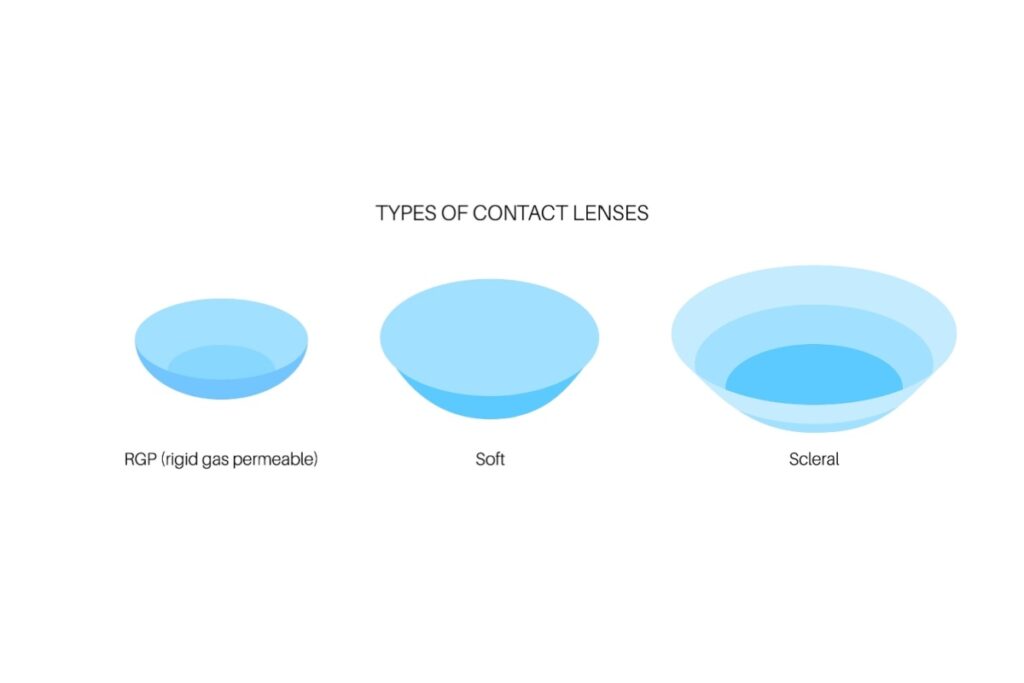
You might have heard about scleral contact lenses if regular contacts haven’t worked for you or if you have an eye condition that makes vision correction challenging. Spectrum Eye Care often recommends these specialized lenses when traditional options fall short, especially for people with conditions that make contact lenses hard to fit.
Scleral contact lenses are large, custom-designed lenses that rest on the white part of your eye (the sclera) and create a protective, tear-filled space over your cornea. They can help people with complex eye conditions achieve clearer, more comfortable vision when other options fall short.
How Scleral Lenses Differ From Regular Contacts
The most noticeable difference is size. While regular contacts are typically about 0.3–0.6 inches across, scleral lenses are larger — about 0.6–0.95 inches in diameter — big enough to completely cover your cornea and rest on the surrounding white tissue.
This unique design creates several key differences in how they work:
- Larger diameter (about 0.6–0.95 inches vs. 0.3–0.6 inches for regular contacts)
- Rest on the sclera (the white part of your eye) instead of the cornea
- Create a tear-filled vault over your cornea for protection and comfort
- Made from rigid gas permeable materials for sharper vision
Like other hard contact lenses, scleral lenses provide sharper vision than soft contacts, particularly for people with astigmatism or irregular corneas.
Who Benefits From Scleral Contact Lenses
These lenses work particularly well for people whose eyes don’t respond to traditional vision correction methods. The tear-filled vault they create can smooth out irregular eye surfaces and provide constant moisture.
Eye Conditions That Respond Well
Several medical conditions can make regular contacts uncomfortable or ineffective. Scleral lenses often provide relief where other options haven’t worked.
- Keratoconus & irregular corneas
- Severe dry eyes
- Corneal transplant patients
- Ocular surface disease
For people with keratoconus, scleral lenses can provide dramatically clearer vision by creating a smooth optical surface over the irregular cornea.
Vision Problems They Can Correct
Complex prescriptions that challenge traditional correction methods often respond well to scleral lenses. The rigid material and custom design can address vision issues that glasses or regular contacts cannot.
- Complex astigmatism
- High prescriptions
- Cases where regular contacts don’t work

How Your Eye Doctor Fits Scleral Lenses
Getting scleral lenses requires several appointments and careful measurements. The process takes more time than regular contact lens fittings because each lens must be designed specifically for your eye shape and condition.
Initial Evaluation & Measurements
The eye doctor starts with detailed measurements of your eye surface. This mapping process helps determine the exact shape and size your lenses need to be.
- Comprehensive eye exam
- Detailed eye surface mapping
- Assessment of your specific needs
Corneal topography creates precise 3D maps of your eye’s surface, helping the eye care team design lenses that match your unique anatomy.
Custom Design Process
Once the initial measurements are complete, you’ll try diagnostic lenses to test fit and comfort. From there, the doctor refines the design to ensure the best vision and comfort possible. This step typically includes:
- Trial fitting with diagnostic lenses
- Fine-tuning lens parameters
- Creating your custom prescription
Daily Life With Scleral Contact Lenses
Living with scleral lenses involves learning new routines for insertion, removal, and care. Most people adapt to these differences within a few weeks of consistent wear.
How Long You Can Wear Them
Your wearing time depends on your specific eye condition and how your eyes respond to the lenses. Some people wear them all day, while others need breaks throughout the day.
- Typical wear time ranges from a few hours to 10+ hours
- Gradual build-up period when you first start
- Option to remove & clean during the day if needed
Insertion & Removal Process
Putting in scleral lenses requires filling them with saline solution before placement. The eye care team provides thorough training on the proper technique.
- Different technique than regular contacts
- Filling lens with saline before insertion
- Training provided by the eye care team
Proper contact lens care becomes even more important with scleral lenses due to their specialized design and custom fitting.
Discover Whether Scleral Lenses Are Right for You
If you’re struggling with regular contacts or have been told that contact lenses won’t work for your eyes, scleral lenses might provide the clarity and comfort you’ve been missing. Our team at Spectrum Eye Care specializes in custom contact lens fittings for complex vision needs, helping Charlotte residents see more comfortably every day.
We offer appointments at three convenient Charlotte locations:
• South End
• Uptown Charlotte
• South Charlotte / Colony Road
Schedule an evaluation today to find out if scleral contact lenses are the right solution for your eyes.